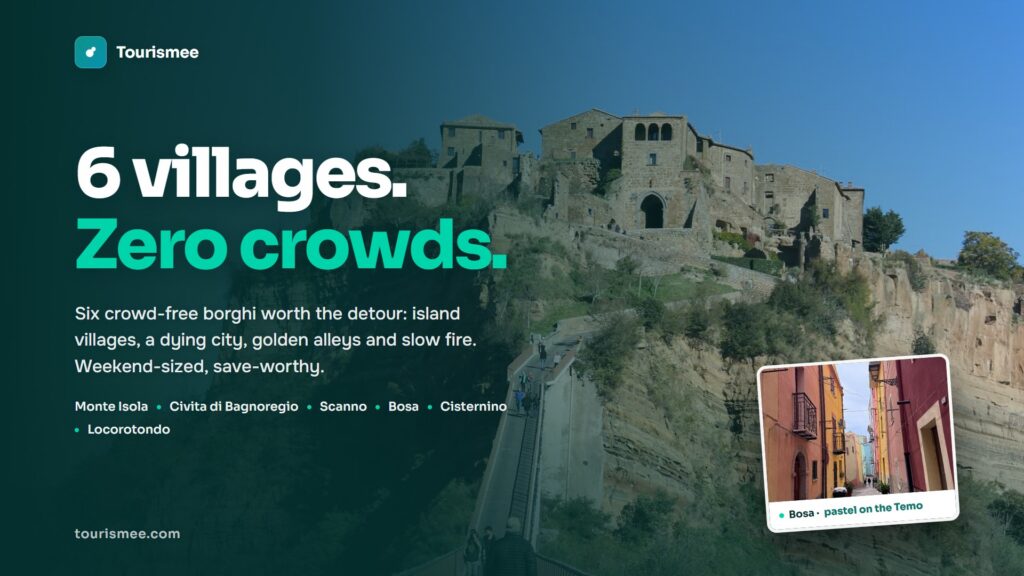
6 Hidden Villages in Italy With Zero Crowds (and How to Visit Them)

Italy receives millions of travellers every year, and most of them queue for the same five streets. But between the icons there’s another country: hidden villages in Italy where the bakery still closes for lunch, the square empties at noon, and nobody sells you a selfie stick.
This is a list of six beautiful Italian borghi without the crowds: one lake island, one dying city, one golden hilltown, one pastel river town, and two white pearls of the Itria Valley. All real, all reachable, all worth a weekend.
Save this page — and when everyone posts the Amalfi Coast next summer, you’ll post an empty piazza.
How we chose these six villages
Three simple rules: real places, not sets — working towns with bakers, churches and nonnas; slow size — everything walkable in a morning; no crowd infrastructure — if it needs turnstiles, it’s not on this list. From Lombardy to Sardinia, north to south.
Monte Isola, Lombardy: the island where cars are banned
Italy’s largest lake island sits in Lake Iseo, a short ferry from Sulzano — and cars simply don’t exist there. Vans are delivered by tractor, the priest walks, and you will too: the whole island is a car-free ridge of olive rows, fishing nets and lake views.
Walk or rent a bike in Peschiera Maraglio, climb to the Sanctuary of the Madonna della Ceriola for the view across the lake, and stop for dried lake fish and a glass of Franciacorta on the water.
Getting there: train to Sulzano (Brescia–Iseo line), then a 5-minute ferry. Best time: late spring and September, when the lake is warm and the weekends are quiet.
Civita di Bagnoregio, Lazio: the dying city
They call it la città che muore — the dying city. Founded by the Etruscans on a hill of soft tuff that the wind and rain keep eroding, Civita is reachable only by a long pedestrian footbridge. No cars, no mopeds, just stone lanes suspended over the badlands.
Walk the silent alleys, peek into the Etruscan tunnels beneath the town, and stay for sunset: when the day-trippers leave, you have one of Italy’s most surreal views almost to yourself. The autumn fog in the valley below is the stuff of photographs.
Getting there: train to Orvieto, then a local bus to Bagnoregio; the bridge starts at the edge of town. Best time: October mornings, with the fog filling the valley of the calanchi.
Scanno, Abruzzo: golden stone above a heart-shaped lake
Between mountains and beech woods, Scanno keeps its golden alleys, its lacemaking grandmothers and a goldsmith tradition that still files filigree by hand. Below the village, the lake bends into a heart shape — best admired from the Frattura lookout, especially at dawn.
Swim in the lake in summer, walk the old town in the afternoon golden light, and eat like it’s Sunday: lamb, aged cheese, and a glass of gentian liqueur that tastes exactly like the mountains around you.
Getting there: bus from Sulmona (railway hub on the Rome–Pescara line) or by car via the Valle del Sagittario. Best time: June and September — lake weather without the heat.
Bosa, Sardinia: pastel houses on the only river town
Sardinia’s only real river town climbs from the Temo in a spill of coral, ochre and pink houses, topped by the Malaspina Castle. Bosa is colour: laundry between pastel walls, blue boats on the river, the whole palette reflected at dusk from the Ponte Vecchio.
Get lost in the Sa Costa district, climb to the castle for the sunset, taste the local Malvasia — one of Sardinia’s oldest wines — and finish at Bosa Marina, where the sea is a ten-minute hop from the square.
Getting there: bus from Oristano or Nuoro, or the scenic Trenino Verde from Macomer in summer. Best time: May–June and September–October, with the light at its softest.
Cisternino, Puglia: whitewashed alleys and the ready grill
In the heart of the Itria Valley, Cisternino is a stack of whitewashed lanes, arches and hidden courtyards — so white it glows at dusk. It’s listed among I Borghi più belli d’Italia, and its old town is a labyrinth you’re meant to get lost in.
Then there’s the fornello pronto, the ritual that makes this village unique: choose your meat at the butcher’s, pay by weight, and they grill it while you wait with a glass of white wine from the surrounding vineyards. Dinner among the locals, no menu needed.
Getting there: Cisternino has a small station on the Bari–Martina Franca–Taranto line; Bari airport is about an hour by car. Best time: spring, when the valley is green and the grills are already lit.
Locorotondo, Puglia: the round town on the balcony
A ring of white houses curling on a hilltop — the name says it: loco rotundo. Locorotondo’s circular old town is a slow loop of cummerse (pointed whitewashed houses), flowered balconies and wine cellars, ending at the Belvedere over the Itria Valley.
It’s also white-wine country: the local DOC pours crisp and mineral, perfect on a terrace at golden hour. Between trulli, olive trees and vineyards, this is the Puglia postcards promise — minus the crowds of its famous neighbours.
Getting there: trains from Bari and Taranto stop in Locorotondo; Alberobello is a 15-minute ride away. Best time: May–June, before the valley gets busy.
How to visit these villages without a car
It’s doable, with patience: trains reach Sulzano (Monte Isola), Orvieto (Civita), Sulmona (Scanno) and the Itria Valley stations (Cisternino, Locorotondo); buses cover Bosa. A car makes Scanno and Bosa easier — but the slowest route is often the point.
FAQ: hidden villages in Italy
What is the most beautiful hidden village in Italy?
Impossible to crown one — but Civita di Bagnoregio is the most surreal, Monte Isola the most peaceful and Locorotondo the most photogenic without being famous.
When is the best time to visit the Italian borghi?
May–June and September–October: mild weather, long light, local life in full swing and high-season crowds gone.
Can you visit them without a car?
Yes: four of the six have a railway station within reach; buses and ferries cover the rest. Allow time — slowness is part of the deal.
Where should you stay?
In the borghi themselves: family-run B&Bs and agriturismi are the whole point. Book direct — small hosts keep the best rates for guests who skip the platforms.
One last thing (for the hosts of these villages)
If you run a B&B, a trattoria or a tour in one of these borghi, this is exactly the audience you want: slow travellers who save lists like this one. Put your village in their pocket — services, experiences and offers in your own app, online in about 30 minutes: tourismee.com.
Save the list. Pick one village. Go before everyone else does.