6 Italian Lakes With Zero Crowds (and How to Visit Them)

When people say “Italian lake” they usually mean one of three names — and in summer, so does everyone else. But Italy is a country of over a thousand lakes, and most of them have no queue, no boat-party calendar and no selfie sticks: just water, mountains and the sound of nothing.
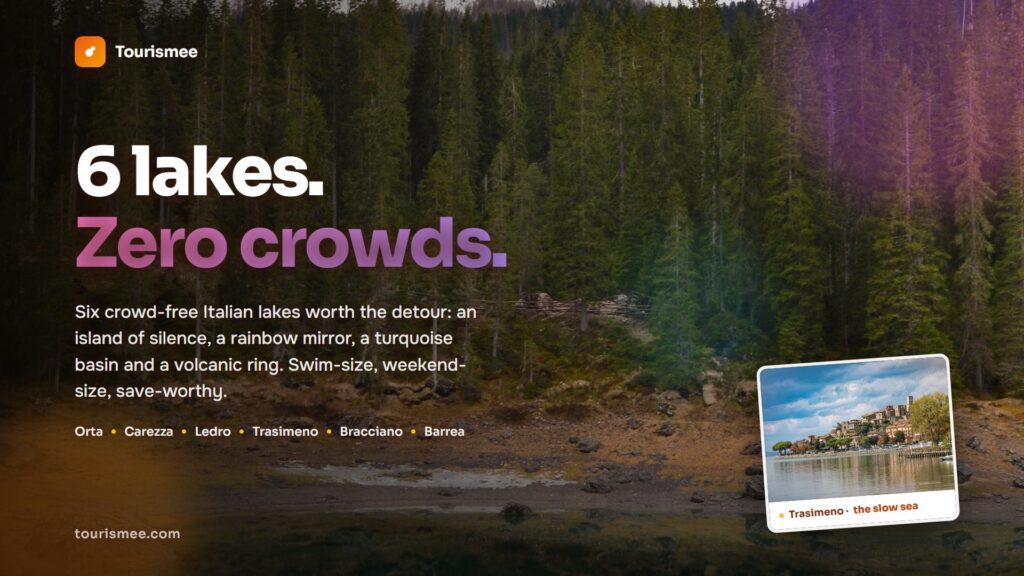
This is a list of six beautiful Italian lakes without the crowds: an island of silence in Piedmont, a rainbow mirror in the Dolomites, a turquoise basin near Garda, a lake that thinks it’s a sea in Umbria, a volcanic ring outside Rome and a wild mirror in Abruzzo. All real, all reachable, all weekend-sized.
Save this page — and when everyone posts Como next summer, you’ll post still water.
How we chose these six lakes
Three simple rules: real places, not sets — lakes with villages, bakers and ferrymen, not resort corridors; slow size — you can swim, walk and eat without a car plan; no crowd infrastructure — if it needs turnstiles and timed tickets, it’s not on this list. From Piedmont to Abruzzo, north to south.
Lago d’Orta, Piedmont: the lake of silence
The smallest and quietest of the northern lakes, hidden just west of Maggiore. Its jewel is Isola San Giulio, a tiny island monastery you walk around on the Via del Silenzio — the Way of Silence — while the water stands perfectly still. Above the village, the Sacro Monte is a UNESCO walk of chapels and views.
Wander Orta San Giulio’s cobbled lanes, take the two-minute ferry to the island, then eat lake fish with a glass of Colline Novaresi wine as the fog rolls in — this lake’s autumn fog is the stuff of photographs.
Getting there: train to Orta Miasino (Domodossola–Milan line), then a short walk or taxi down to the lake. Best time: late spring and September; October for the fog.
Lago di Carezza, South Tyrol: the rainbow of the Dolomites
A small alpine jewel at 1,520 metres in the Val d’Ega, sitting right under the pale walls of the Latemar. Carezza is famous for its rainbow water — green, blue and gold in the same glance — and for its legend: a rainbow thrown to the ground by a wizard who tried, and failed, to capture a nymph.
Swimming is banned (the lake is protected), and that’s the point: you come to look. The flat circular path takes twenty minutes and gives you the classic mirror shot of the Latemar; in early summer the meltwater is high, in autumn the larches turn gold around it.
Getting there: bus from Bolzano through the Eggental, or car via the Passo di Costalunga. Best time: June for full water, late September–October for colour.
Lago di Ledro, Trentino: turquoise at 650 metres
Ten kilometres from Riva del Garda but a world away, Ledro is a turquoise mountain basin ringed by beaches, lawns and quiet. The water is clear and swimmable, the shores are for SUPs and slow afternoons, and the villages — Molina, Pieve, Mezzolago — are one-pizzeria places, not resort strips.
The lake also guards something unique: a 4,000-year-old pile-dwelling village, part of a UNESCO serial site, with an excellent lakeside museum. Prehistory before lunch, a swim after.
Getting there: bus from Riva del Garda, or car through the Val di Ledro. Best time: June and September — warm water, empty lawns.
Lago Trasimeno, Umbria: the lake that thinks it’s a sea
Italy’s fourth-largest lake is shallow, soft and horizon-wide — on a summer afternoon you’d swear it was the coast. But it stays slow: reeds, fishing boats, swim-size beaches, and islands you can hop by boat — Isola Maggiore with its lace-makers, Isola Polvese with its woods and quiet.
Base yourself in Castiglione del Lago or Passignano sul Trasimeno, cycle the flat shore path, and dig into the area’s layered history: Etruscan walls, and the field where Hannibal ambushed a Roman army in 217 BC.
Getting there: trains on the Florence–Perugia line stop at Castiglione del Lago, Passignano and Tuoro. Best time: May–June and September.
Lago di Bracciano, Lazio: a volcano one train from Rome
Forty minutes from Rome by regional train, Bracciano is a volcanic ring of water so clean it supplies the capital’s taps — which keeps motorboats off and swimming lovely. Three towns share the shore: Bracciano with its huge Orsini-Odescalchi castle, Anguillara Sabazia with its pastel old town on a spur, and food-loving Trevignano Romano.
Sail or paddle the blue water, walk the lakeside promenades, eat coregone (lake fish) and porchetta in a village square. It’s the rare Italian lake that works as a car-free day trip from a big city — and still feels like an escape.
Getting there: FL3 regional train from Rome (Ostiense/Trastevere) to Bracciano or Anguillara. Best time: spring and early autumn; summer weekdays.
Lago di Barrea, Abruzzo: the mirror of the national park
Inside the Abruzzo, Lazio and Molise National Park, Barrea is the wildest lake on this list. The village of Villetta Barrea sits right on the water and doubles itself in the reflection; deer graze at dusk, and the woods around hide the marsican bear and the wolf — this is the Italy of nature documentaries.
Swim off the small beach, walk the lakeside loop, then head up to Barrea’s rocky old town for the view. Everything here runs on park time: slow, quiet, and closed for lunch.
Getting there: car from Sulmona or Avezzano (seasonal buses in summer). Best time: June and September; October for the foliage.
How to visit these lakes without a car
Four of the six work well by train: Orta (Orta Miasino), Trasimeno (three stations), Bracciano (FL3 from Rome) and — with a bus hop — Ledro from Riva del Garda, itself reachable by train. Carezza needs a bus or car from Bolzano; Barrea really wants a car. As always in slow Italy: the detour is the destination.
FAQ: lakes in Italy without the crowds
What is the most beautiful uncrowded lake in Italy?
Impossible to crown one — but Carezza is the most surreal, Orta the most romantic and Barrea the wildest.
When is the best time to visit the Italian lakes?
May–June and September–October: warm water, long light and high-season crowds gone. October adds fog on Orta and gold on Carezza.
Can you swim in these lakes?
Yes in Ledro, Trasimeno, Bracciano and Barrea (and in Orta in summer). Carezza is protected — look, don’t dip.
Where should you stay?
In the small towns on the shore: family-run B&Bs and agriturismi are the whole point. Book direct — small hosts keep the best rates for guests who skip the platforms.
One last thing (for the hosts of these lakes)
If you run a B&B, a sailing school or a trattoria on one of these shores, this is exactly the audience you want: slow travellers who save lists like this one. Put your lake in their pocket — services, experiences and offers in your own app, online in about 30 minutes: tourismee.com.
Save the list. Pick a lake. Go before everyone else does.